

Corn Adjunct Brewing: Brewing Methods, Benefits & Challenges
Brewing Process, Benefits, Challenges & Equipment Requirements
1. Introduction to Corn Adjunct Brewing
Corn is one of the most widely used adjunct ingredients in commercial beer production. It is commonly used to replace a portion of the malted barley in order to optimize raw material costs and adjust the flavor, color, and body of the finished beer.
In commercial brewing, corn is particularly suitable for producing pale lager beers, light lagers, and other refreshing beer styles.
Unlike malted barley, corn contains a high proportion of starch but has very little natural enzyme activity. Therefore, additional processing is required to convert its starch into fermentable sugars.
The correct use of corn can help breweries achieve a balance between production costs, brewing efficiency, and beer quality.
2. Types of Corn Used in Brewing
Three main forms of corn are commonly used in brewing:
|
Corn Type |
Characteristics |
Brewing Application |
Corn Type |
| Corn Grits | Coarsely milled corn with high starch content | Requires separate cooking and gelatinization | Corn Grits |
| Flaked Maize | Pre-cooked and rolled corn | Can be added directly to the mash tun | Flaked Maize |
| Corn Flour | Finely ground corn | Requires careful handling to avoid clumping | Corn Flour |
Our recommendation: Corn grits and flaked maize are the preferred choices for most commercial breweries.
- Corn grits are suitable for large-scale industrial breweries with a dedicated cereal cooking system.
- Flaked maize is ideal for small and medium-sized breweries because of its simpler processing requirements.
3. Main Corn Brewing Methods
There are two primary methods for incorporating corn into the brewing process.
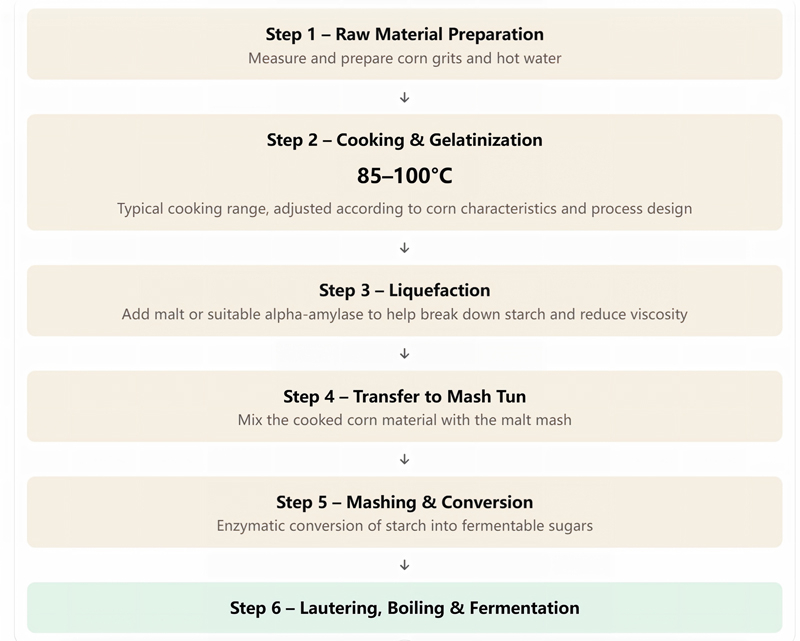
Corn starch must be gelatinized before malt enzymes can efficiently convert it into fermentable sugars.
The cooking process makes the starch accessible to enzymes and improves the overall conversion efficiency.
Important Process Considerations
- Maintain continuous agitation during corn cooking to prevent burning and sticking.
- Ensure complete starch gelatinization.
- Use appropriate enzymes or malt to assist liquefaction.
- Consider additional steam consumption when designing the boiler system.
Method 2: Direct Mashing with Flaked Maize
Flaked maize has already undergone steaming and rolling during its manufacturing process. Its starch is generally pre-gelatinized, making it suitable for direct addition to the mash tun.
Typical Operating Procedure
1. Weigh the malted barley and flaked maize according to the recipe.
2. Mix the ingredients and transfer them into the mash tun.
3. Add brewing water and start the mashing process.
4. Maintain a typical mash temperature of 63–68°C.
5. Allow approximately 60–90 minutes for enzymatic conversion, subject to recipe validation.
6. Check starch conversion using an iodine test.
7. Proceed with lautering, wort boiling, cooling, and fermentation.
Key Advantages:
- No separate cereal cooker is normally required.
- Simpler equipment configuration.
- Lower equipment investment.
- Easier operation and shorter process preparation time.
The malt must still provide sufficient enzymatic activity to convert the corn starch effectively.
4. Recommended Corn Addition Ratios
The corn percentage is calculated based on the total weight of the grain bill.
Corn Percentage Application Main Characteristics
5–10% Craft Beer Slight adjustment to flavor and body
10–20% Commercial Beer Good balance between cost and quality
20–30% Industrial Lager Greater malt replacement and lighter body
These percentages are practical starting points rather than universal brewing standards. Actual formulations depend on malt enzyme activity, target original gravity, beer style, and filtration performance.
Recommended Starting Formula
80% Malt + 20% Corn
A practical starting formulation for commercial pale lager production. Pilot brewing trials should be conducted before full-scale production.
5. Benefits of Using Corn in Beer Brewing
01. Lower Raw Material Costs
Corn can replace part of the malted barley when its purchase price is lower. This helps breweries optimize ingredient costs and improve production economics.
02. Lighter Beer Body
Corn can help produce a lighter and smoother beer with a clean, refreshing drinking character.
03. Lighter Beer Color
Corn is relatively low in color compared with many malt varieties, making it useful for producing pale-colored lager beers.
6. Disadvantages and Technical Challenges
Although corn provides several advantages, excessive or improper use may create production and quality problems.
|
Potential Problem |
Main Cause |
Recommended Solution |
| Reduced Foam Stability | Lower contribution of malt-derived foam-active proteins | Optimize malt percentage and grain bill |
| Insufficient Yeast Nutrition | Corn provides less assimilable nitrogen and some micronutrients than malt | Monitor FAN/YAN and supplement nutrients when necessary |
| Lower Conversion Efficiency | Corn has little natural enzyme activity | Use high-enzyme malt or suitable enzyme preparations |
| Increased Energy Consumption | Additional cooking and gelatinization | Optimize the cereal cooking system |
| Filtration Difficulties | Changes in grain composition and husk content | Optimize mash filtration and lauter bed |
Three critical factors require particular attention:
1. Enzyme Activity: The malt must have sufficient diastatic power to convert the additional corn starch.
2. Yeast Nutrition: High corn percentages may reduce the availability of essential nutrients. Monitor free amino nitrogen (FAN).
3. Foam Quality: Excessive malt replacement can negatively affect foam retention and beer body.
7. Impact on Brewery Equipment Configuration
When designing a brewery that uses corn as an adjunct, the equipment configuration should be adjusted according to the selected raw material and production capacity.
|
Equipment |
Design Considerations |
| Malt Mill | Separate corn milling or a dedicated corn grinder may be required |
| Cereal Cooker | Recommended for raw corn grits |
| Mash Tun | Sufficient mixing capacity and enzymatic conversion conditions |
| Lauter Tun | Adequate filtration area and drainage capacity |
| Steam Boiler | Additional steam demand for corn cooking |
| Wort / Mash Pumps | Suitable capacity for higher-viscosity materials |
04. Clean Flavor Profile
Properly processed corn can contribute a mild grain character while reducing the intensity of malt flavor.
8. Recommended Brewing Process for Commercial Lager
For commercial pale lager production, we recommend starting with a grain bill containing 80% malted barley and 20% corn.
9. Final Recommendations
Corn adjunct brewing is an effective approach to optimizing commercial beer production. It offers breweries greater flexibility in raw material selection, production costs, and finished beer characteristics.
The choice between corn grits and flaked maize should be based on production capacity, equipment investment, energy consumption, and the desired brewing process.
10. Conclusion
Better Ingredients. Smarter Brewing. More Efficient Production.
Corn adjunct brewing is not simply about replacing malt with a cheaper ingredient. It is about developing an optimized brewing process that balances raw material costs, brewing efficiency, beer quality, and equipment investment.
With the right ingredient selection, process control, and equipment configuration, breweries can produce consistent, high-quality lager beers while improving overall production economics.
Your Trusted Partner in Brewing Solutions.
Post time: Nov-28-2026