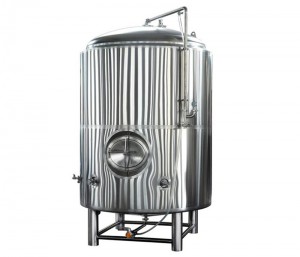


General description
Stainless Steel Mixing Tanks
Stainless steel mixing tanks for beverages are essential equipment in the beverage industry. They are used for mixing, blending, and storing various beverages. Here is an introduction to their characteristics and related information:
Structural Features
•Material: Usually made of food - grade stainless steel, such as SUS304 or SUS316L. These materials are corrosion - resistant, easy to clean, and meet food safety standards.
•Inner Surface Treatment: The inner surface of the tank is mirror - polished, with a roughness Ra≤0.4μm, which helps to prevent the adhesion of materials and is convenient for cleaning, reducing the risk of microbial growth.
•Jacket Structure: Many beverage mixing tanks have a jacket structure, which can be used for heating or cooling. The heating methods include electric heating, steam heating, etc. The jacket can be filled with heat - transfer oil, water, etc. as the heating medium.
•Agitation system: Equipped with a stirring device, the stirring speed is usually 15 - 120r/min. The form of the stirring paddle can be frame - type, anchor - type, paddle - type, turbine - type, etc., which are selected according to the process requirements.
Capacity and Specification
The volume of stainless steel mixing tanks for beverages ranges from 50L to 20000L or even larger, and can be customized according to the actual production needs of users.
Accessories
•port fitting: There are liquid level meter ports, CIP cleaning ports, air breathing ports, thermometer ports, sight glasses, etc., which are convenient for process operation and equipment maintenance.
•mixing seal: The seal of the agitator adopts a sanitary mechanical seal or a magnetic full - seal stirring device to ensure the tightness of the tank and prevent material leakage and external pollution.
Applications
They are widely used in the production of various beverages, such as fruit juice beverages, carbonated beverages, dairy beverages, etc. They can be used for mixing raw materials, blending flavors, and storing intermediate products in the production process.
Dimension of mixing tanks
| Capacity(Liter) | Diameter(mm) | Total Height(mm) |
| 1000L | 1100 | 2200 |
| 1500L | 1300 | 2200 |
| 2000L | 1300 | 2550 |
| 3000L | 1600 | 2550 |
| 5000L | 1900 | 3000 |
| 6000L | 1770 | 3500 |
| 7500L | 2000 | 3500 |
| 8000L | 2050 | 3500 |
| 10000L | 2100 | 4000 |
| 12500L | 2100 | 4900 |
| 15000L | 2150 | 5500 |
| 20000L | 2250 | 5950 |